


Six months on from our Community Resilience Assembly

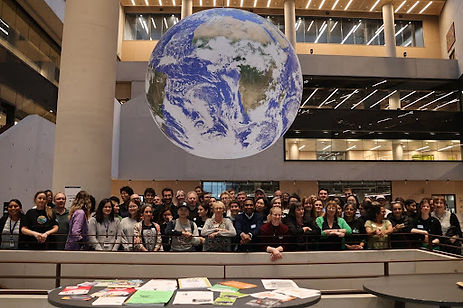
Our Community Resilience Assembly was held in November 2025 at UCL East, bringing together 120 community organisers and UCL students. Six months on, we thought it would be useful to look back on the experience. Below is a blog written by one of the attendees, Louisa Cavell from London Resilience. Thank you for her contribution and hope you enjoy her perspective!
Attending the Community Resilience Assembly
By Louisa Cavell, Communications Manager – London Resilience
On 5th and 6th November of this year, I was lucky enough to participate in the very first Community Resilience Assembly, bringing together community organisers, University College London (UCL) students, and resilience practitioners for two days of peer-to-peer learning and collaboration. The event was delivered by Islington Climate Centre in partnership with UCL Students’ Union, UCL Grand Challenges, London Resilience, and the Network for Social Change.
As a member of one of the co-sponsoring organisations, and as the Communications Lead for London Resilience I had high hopes for what the two days would bring, hopes which were not disappointed.
The Assembly aimed to explore how communities can strengthen their collective capacity to respond to social and environmental challenges, building on the frameworks and strategies outlined in the London Community Resilience Toolkit, a document produced by London Resilience, which offers practical information and guidance to help communities better prepare for and respond to future challenges and emergencies. Bringing UCL students together with local leaders from across London, the Assembly facilitated a unique opportunity for intergenerational, cross-sector and socio-economically and politically diverse exchanges.
The mix of attendees brought an interesting mix to conversations, especially around themes like inclusion, accessibility and breaking down barriers to engage with seldom heard communities.
The venue, Marshgate, UCL East Campus, proved to be both atmospheric, with the Gaia artwork suspended from the ceiling, and conducive to really in-depth discussions about what challenges communities face and the ways that we can tackle them together.
The keynote speaker was Miriam Levin, Director of Participatory Programmes at Demos, a cross-party think tank, working to a people-centred approach, called collaborative democracy. We also heard from other prominent voices in the resilience space, such as Kristen Guida, the Head of Strategy, Prevention, and Community Resilience at London Resilience, who spoke about the exciting opportunities in funding and programmes, including the Community Resilience Fund, the Our Future, Our Resilience programme, Climate Connected Communities and the upcoming development of a Community Risk Register for London.
Across the two days, myself and the other participants took part in a series of interactive seminars and workshops, which covered key themes like:
· Community mapping and local power
· Well-being and mutual support
· Food systems and sustainability
· People’s assemblies and participatory democracy
· Community energy
· Emergency preparedness
Of these, I wanted to explore the sessions that I specifically attended, beginning with the first day and the first session: Communications for change with and others, presented by Stephanie Bleach from Zero Carbon Guildford, which was facilitated by Paul Thistlethwaite.
One of the most powerful parts of the two days was actually the point where we were all evacuated from the building for a fire alarm, which happened while I was in this this particular session.
While on the face of it, the evacuation of all the delegates to a grey day outside was not an ideal scenario, by any means. However, it actually proved to be the perfect vehicle for showcasing resilience in action as one by one, each of the sessions resumed outside, without any of the bells and whistles of technology, just the raw power of the speakers engaging with their groups and those groups giving space, attention and respect, keeping the momentum of the day going and ensuring that the wealth of experience and insight could be shared, even in adverse conditions. For me, it really showcased the power of a group of people wanting to learn and making the best of a difficult situation, which at it’s heart is what community resilience is about. The case study of Carbon Guildford is an excellent example of how a community group, with a small amount of funding and some strong leadership, can actually have a huge impact on their community.
One thing that drew me to the session initially was the idea that a powerful idea needs a powerful voice to make an impact. During the session, Stephanie outlined proven communication strategies that helped mobilise the town of Guildford, as well offering practical tips on storytelling and engagement. It’s a session that stayed with me because of how clearly it articulated the need for and role of community engagement and a strong voice within that community but also because of how well Stephanie adjusted to the challenge of being outside in less-than-optimal conditions and still getting the salient points across in an impactful way.
Another session that I attended was creating a Climate action plan with Joolz Thompson, from Community Climate Action.
It can be difficult to articulate the need to move from concerns around climate to something definitive and actionable. This session helped explore the process of building a community-led climate action plan, with a clear roadmap to help communities take action, like engaging with neighbours, setting meaningful goals, and turning a shared ambition into a powerful local movement. These are steps that I’ll take back to communications thinking around specific London Risks, such as surface water flooding and hot weather with a clearer idea of how to turn complex policy language into assets that will help inform and educate communities, with their input and an understanding their unique needs and challenges.
As a communications expert, I found the Communications: Misinformation Workshop with Paul Thistlethwaite session particularly interesting and relevant, both from a personal standpoint but also through the lense of the work that London Resilience is currently undertaking around the themes of mis and disinformation. The risk of dis and mis information is growing and the spread of both is happening faster than ever. This session provided a hands-on assembly to discover how to build community resilience through media literacy, regulation, and collective action, with real world examples that we discussed in different groups, then brought our findings together at the end. It was interesting to see different risks emerge from the different groups, it provoked thoughts around the need to enable our trusted community voices to take a lead in our communications, as they have a powerful position within communities.
The final session I attended was Emotional Resilience: Reflect, Reset, Renew with Chantal Burns from the Conscious Leadership School and Nick Drew, from Climate Psychology Alliance. I felt that it was an important session to attend, as a lot of what we do in the work around resilience can be emotionally draining. It reflects back to the age-old adage of putting your oxygen mask on before helping others, a philosophy I try to live by. The session provided a time of quiet reflection, an opportunity to explore different worries and to come together for group exercises where we were able to try to unpack them.
We all had a lot of fun at the drink reception on the first evening, hearing moving[LC1] spoken word poetry from Salena Godden, and printing fish shapes to add to a large canvas board with all of the different people and organisations reflected. A lovely visual representation of the diversity of groups coming together to learn and collaborate.
The two days culminated in a People’s Assembly, my first time attending one, which offered an open forum for shared reflection, discussion about what we’d learned and how we might take forward some next steps. We learned how to operate in a way that is in a way that is fair, inclusive, and truly democratic.
Aniera Roose-McClew, co-founder of Trust the People expertly facilitated, using prior knowledge and taking thoughtful feedback on issues like accessibility throughout the session. The session enabled participants to take away the format and run their own assemblies, hopefully thereby fostering genuine community-led decision-making.
At a time when increasingly it feels difficult to find hope in the future, the assembly brought some light to my ways of thinking. It was really powerful to see the passion from people of very different backgrounds and experiences, being able to see and explore the different specific challenges that communities are facing, but also, importantly, some solutions.
It was really interesting to see how all of the different groups and viewpoints interacted together. In addition, there was some moderated discussion of extremely complex issues broken down into something understandable to a wide group of people and shared in the way of challenges but also in terms of solutions. Going forward, what I’d like to see is even more collaboration on these issues. Looking from the viewpoint of being in a position to help reinforce a people-centred approach to resilience, I’m going to take a lot of what I learned along with me to ensure that communications are tailored for communities and with their input.


Comments